
Neurocognitive bases of immediate learning success and lexical consolidation of second language words in older adults: a multi-modal (MRI/EEG) study on medial temporal lobe functions
PI: William S-Y. Wang
Co-Is: Manson C-M. Fong & Alma M. L. Au
Funding body: HKRGC-GRF 15606119
Language is made possible in the brain by a process called exaptation, in which existing neurobiological systems supporting specific cognitive functions are recruited to subserve various language functions.
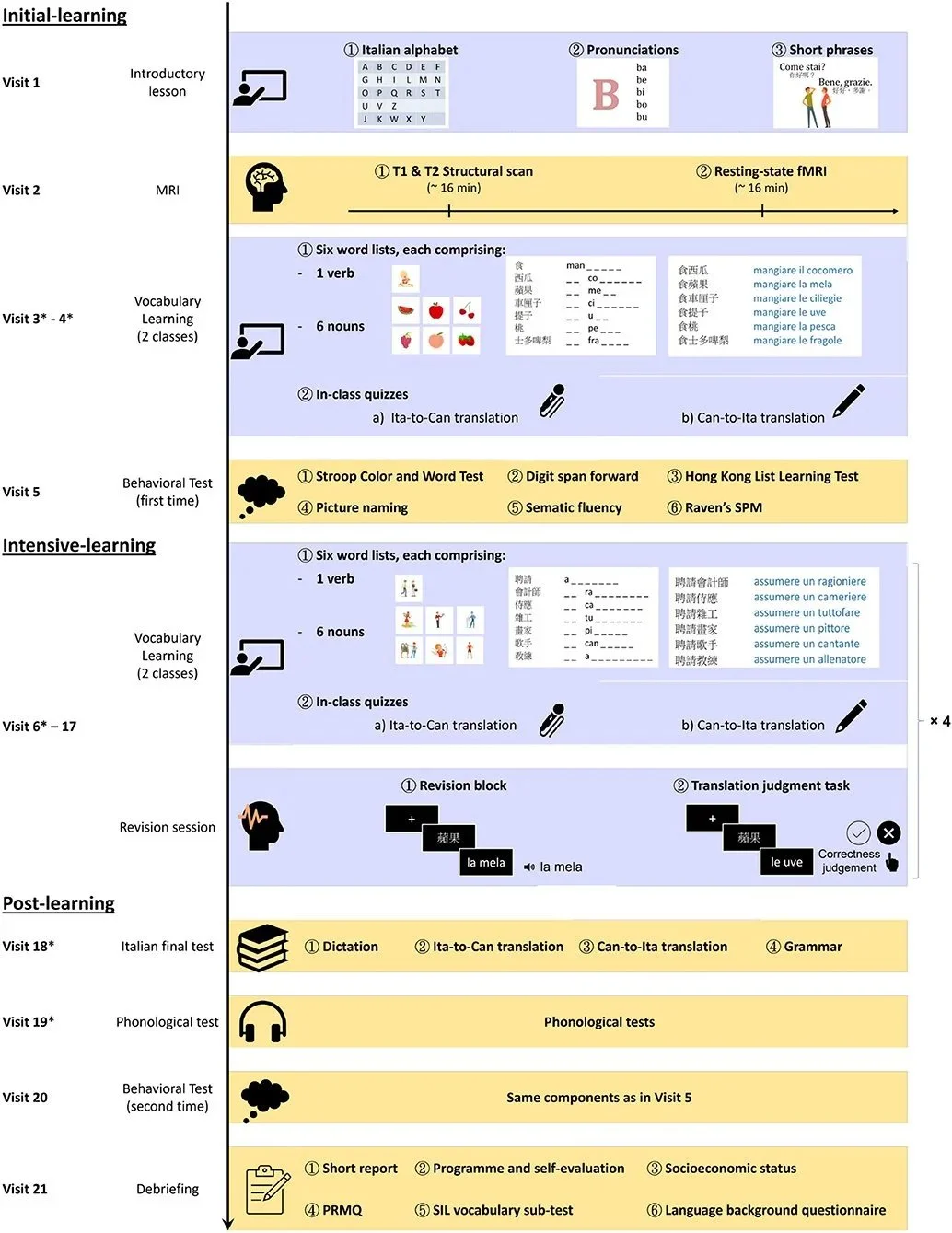
In light of the complex nature of language, the present study aims to investigate the neurocognitive factors, especially those related to memory functions, that determine second language (L2) learning success (both immediate and long-term). We focus on four primary issues:
the functional connections of the medial temporal lobe (MTL) memory system, especially the hippocampus, that support L2 vocabulary learning;
the age-related changes in neural mechanisms, with respect to episodic encoding and retrieval of recently learnt L2 words;
the age-related differences in the lexical consolidation process of recently learnt L2 words; and
the individual differences in L2 learning success.
Publications
Foreign language learning in older adults: anatomical and cognitive markers of vocabulary learning success.
Fong, M. C-M., Ma, M. K-H., Chui, J. Y. T., Law, T. S-T., Hui, N. Y., Au, A., & Wang, W. S. (2022).
Frontiers in Human Neuroscience, 16, 787413. [link]